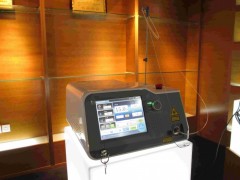
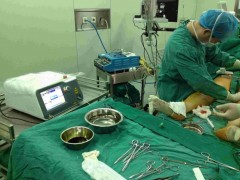
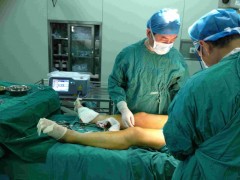
1470-nm diode laser for endovenous ablation of incompetent saphenous veins
Most of the published EVLA data concern 810, 940, 980 nm diode lasers and
1064 or 1320 nm Nd:Yag laser systems. Major side effects are postoperative pain and bruising. The aim of this study was to show the outcome one year after EVLA of incompetent saphenous veins with a 1470 nm Diode laser (Ceralas E, biolitec). Patients and method: Between December 2006 and February 2007, 134 saphenous veins (108 GSV, 26 SSV) in 117 legs of 100 consecutive patients where treated by EVLA for GSVand SSV incompetence. All patients were examined clinically and with duplex by an experienced phlebologist prior to intervention, and at the follow-up visits for complications, occlusion, flow and reflux in the treated vein segment. The clinical evaluation included clinical CEAP and the presence of recurrent varicose veins. Patient satisfaction was assessed by a 0 to 4 scale.
After a mean follow-up period of 184 days (SD 27) 127 treated veins (102 GSV, 25 SSV) of 111 limbs in 94 patients and after 329 days (SD 14) 105 treated veins (94 GSV, 21 SSV) of 105 limbs in 83 patients were reinvestigated. Six patients were lost to follow up after six months
and an additional 11 patients after one year. Up to one year follow-up all treated veins remained occluded. At six months, one new insufficient anterior accessory saphenous vein (AASV) and after 12 months, three new insufficient AASV occurred. After one year 45 patients were very satisfied with the method, 34 were satisfied, three were fairly and one was not satisfied. The mean of all answers was 0.5 (SD 0.5). In three cases phlebitic reactions after 10 days, but no severe complications such as deep vein thrombosis occured. After six months in 9.5% of the legs paresthesia was present in the treated area which reduced to 7.6% after one year. Intake of painkillers was mean 6.7 tablets (SD 3.5). When we compared GSV legs treated with LEED below or above 100 J/cm, the paresthesia rate was significantly lower in the first group with 2.3% compared to 15.5 % in the higher LEED group. The differences for number of days with analgesic intake and for the paraesthetic area were significant.
In this prospective follow-up study with 100 consecutive patients and 134 treated saphenous veins a high occlusion rate of 100% could be demonstrated one year after treatment. However, with LEED . 100 J/cm in this study, the incidence of paresthesia rose significantly. Therefore it seems adequate to stay below 100 J/cm in the future as the occlusion rate was the same below and above 100 J/cm.